Decentralized micropayment channels for autonomous AI agents over libp2p




Quick Start · Architecture · CLI & API · Ecosystem Alignment · Contributing
Agents discover each other via mDNS, negotiate service terms over libp2p streams, exchange Filecoin-style signed payment vouchers off-chain, and settle on Ethereum, Algorand, or Filecoin FEVM. Built for the Filecoin Agents ecosystem and the ARIA Scaling Trust programme.
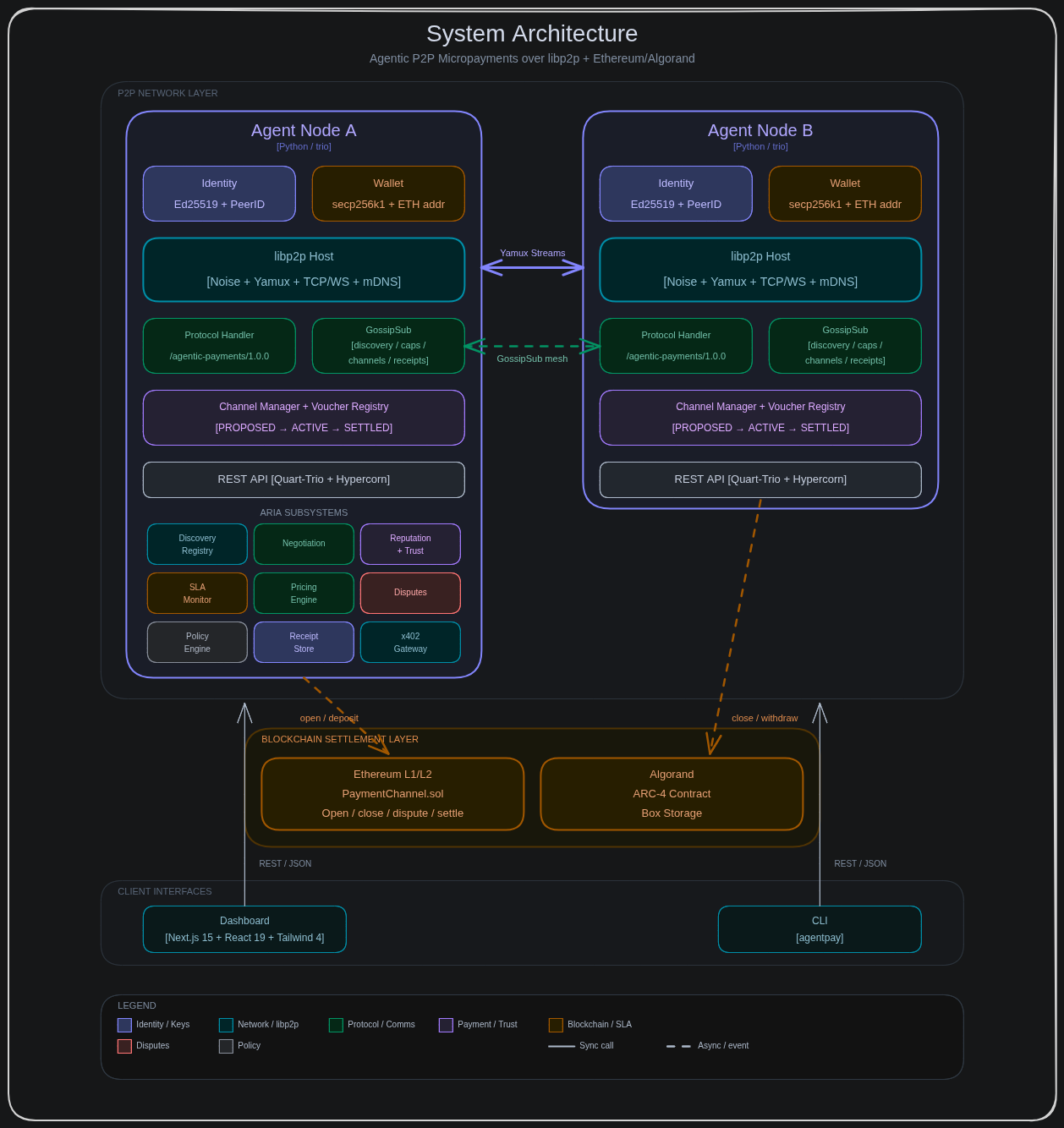
AgentPay is structured as a modular agent runtime with six layers:
- Networking — py-libp2p 0.6.0 with TCP/WebSocket transports, Noise encryption, Yamux multiplexing, mDNS discovery, and GossipSub pubsub
- Wire Protocol — 13 message types over length-prefixed msgpack streams (
/agentic-payments/1.0.0), covering payments, HTLCs, negotiations, and announcements. TaskId correlation on vouchers for per-request settlement attestation - Payment Channels — Filecoin-style cumulative vouchers with ECDSA signatures and task correlation, HTLC multi-hop routing via reputation-weighted BFS, one-shot x402 stateless payments, and a 6-state channel lifecycle
- Settlement — Tri-chain: Ethereum (Solidity
PaymentChannel.sol), Algorand (ARC-4 + box storage), and Filecoin FEVM (same contract on FEVM with f4 address support) — selectable at startup - Identity — ERC-8004 on-chain agent registration (ERC-721 identity token), EIP-191 PeerId-to-wallet cryptographic binding, reputation sync, and discovery fallback
- Trust Layer — Reputation scoring, GossipSub peer scoring (time-in-mesh, first-delivery, app-specific weights), SLA monitoring, dynamic pricing engine, dispute detection, wallet policies, standardized payment error codes, and hash-chained signed receipt audit trails
- Storage — IPFS content-addressed pinning for receipts and capabilities, with CID-based retrieval and GossipSub broadcast
- Interfaces — Quart-Trio REST API (~50 endpoints), Typer CLI (~50 commands), and a Next.js 15 real-time dashboard
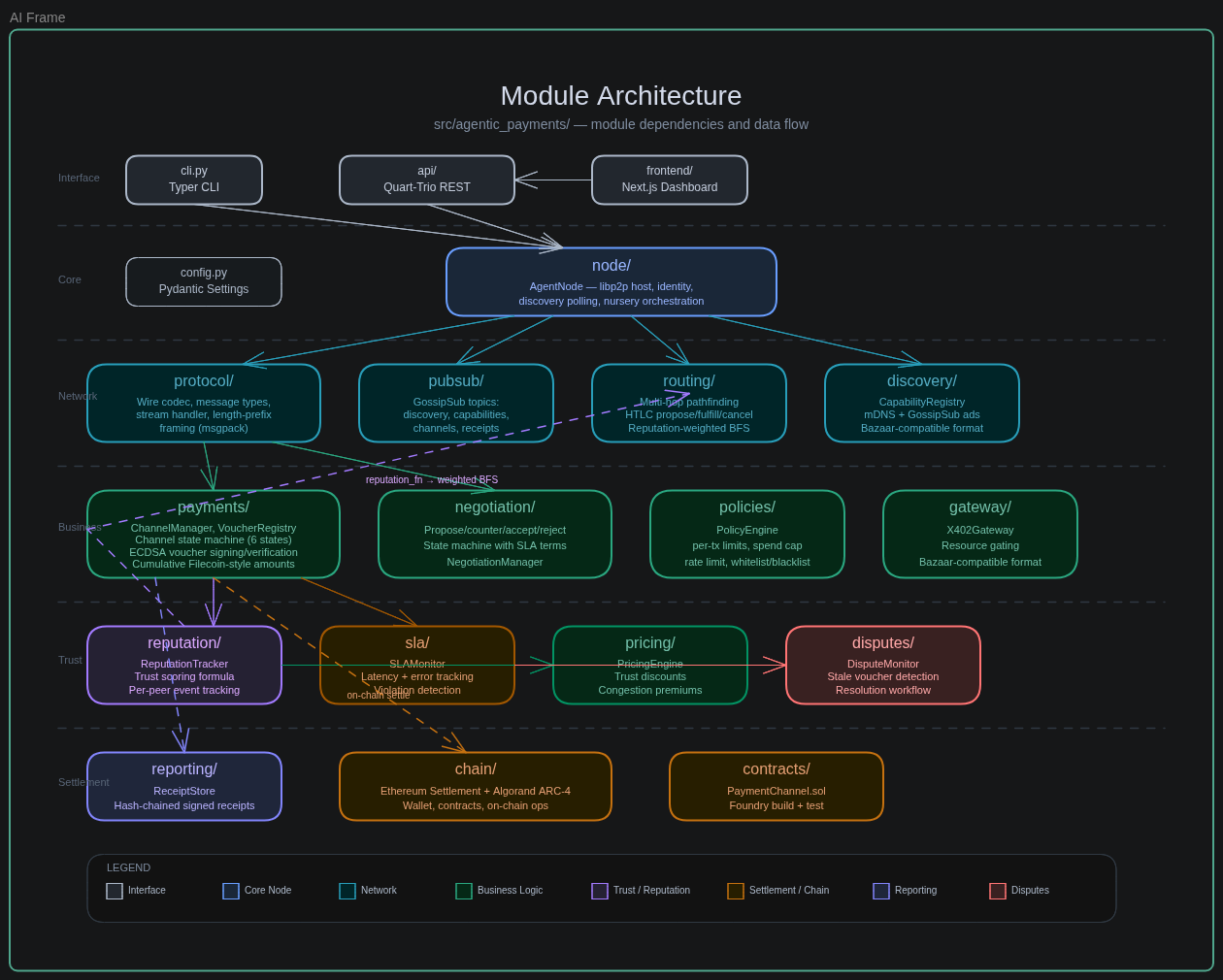
Module dependency map — interface, core, network, business, trust, and settlement layers
See ARCHITECTURE.md for the full system design with 13 architecture diagrams.
- Python 3.12+ and uv (
curl -LsSf https://astral.sh/uv/install.sh | sh) - Node.js 22+ (for the dashboard)
- Docker (optional — PostgreSQL + Anvil for on-chain settlement)
# Install dependencies
uv sync --group dev

# Start agents + dashboard (recommended)
./scripts/dev.sh              # 2 agents + frontend at localhost:3000
./scripts/dev.sh --agents 3   # 3 agents

# Or start manually
uv run agentpay start --port 9000 --api-port 8080curl http://127.0.0.1:8080/health # {"status":"ok","version":"0.1.0"}
curl http://127.0.0.1:8080/identity # peer_id, eth_address, listen addrs
curl http://127.0.0.1:8080/peers # discovered peers# Open a payment channel (locks 1 ETH deposit)
curl -X POST http://127.0.0.1:8080/channels \
-H "Content-Type: application/json" \
-d '{"peer_id":"12D3KooW...","receiver":"0xAbC...","deposit":1000000000000000000}'
# Send micropayments (off-chain, sub-millisecond)
curl -X POST http://127.0.0.1:8080/pay \
-H "Content-Type: application/json" \
-d '{"channel_id":"abcdef01...","amount":100000000000000}'The Next.js dashboard at localhost:3000 provides a real-time multi-agent network view.
| Network Graph | Interactive force-directed graph — click nodes to open channels, click edges to send payments. Trust-colored nodes (green/amber/red). |
| Trust Panels | Discovery, negotiations, receipt chains, wallet policies — all in the left sidebar. |
| Simulation | Batch payment rounds, topology control (mesh/ring/star), success rate tracking. |
| Actions | Open channels, route multi-hop HTLC payments, propose service negotiations. |
| Monitoring | SLA violations, dispute scanning, dynamic pricing quotes, live event feed. |
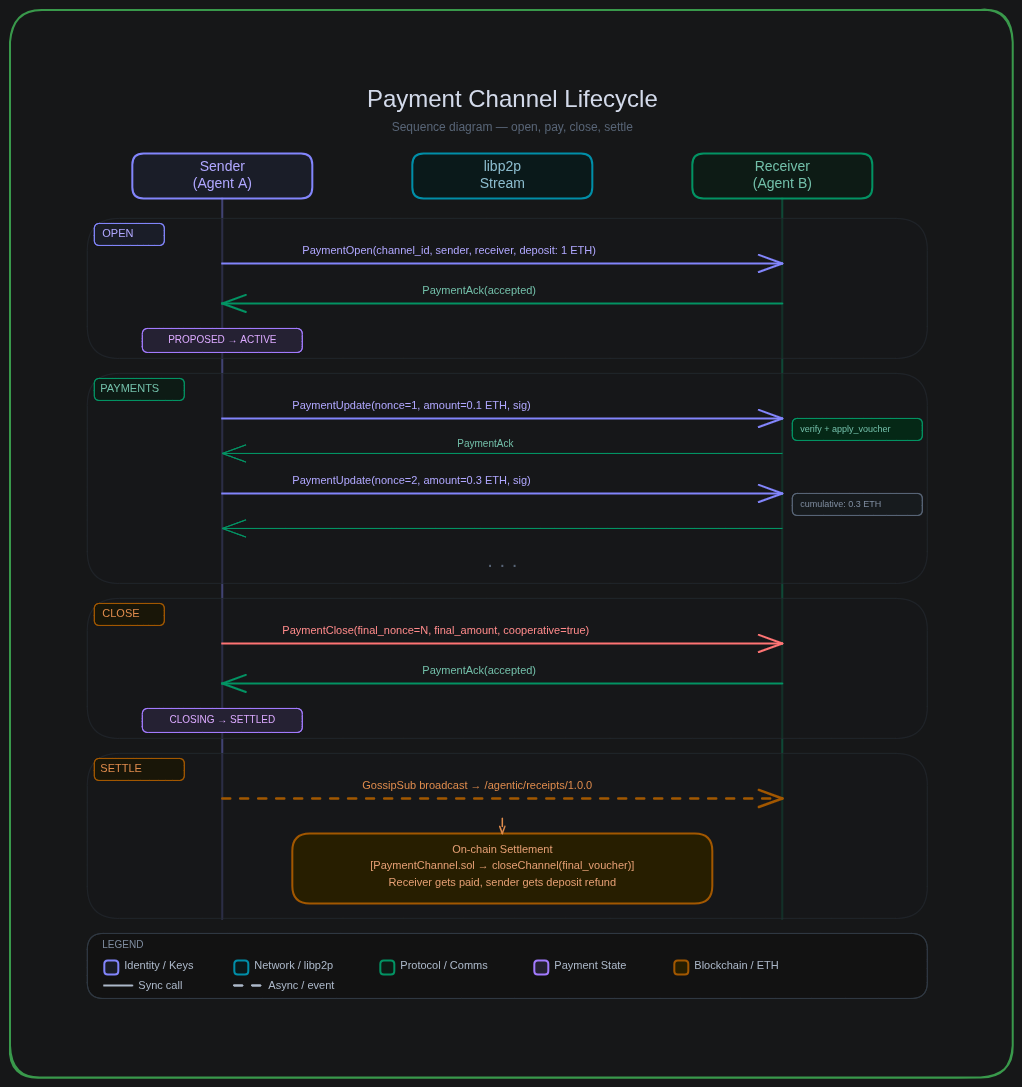
Payment channel lifecycle — open, pay, close, settle
agentpay start [--port 9000] [--api-port 8080] [--eth-rpc URL]   # Start agent node
agentpay identity generate                                         # Create Ed25519 keypair
agentpay channel open --peer <id> --deposit <wei>                  # Open payment channel
agentpay pay --channel <id> --amount <wei>                         # Send micropayment
agentpay negotiate propose --peer <id> --service compute           # Negotiate terms
agentpay reputation list                                           # View trust scores
agentpay dispute scan                                              # Detect stale vouchers
agentpay pricing quote --service inference                         # Dynamic price quote
Full CLI reference with all subcommands: COMMANDS.md
~50 JSON endpoints across 10 groups. CORS enabled. Default: http://127.0.0.1:8080
| Group | Endpoints | Description |
|---|---|---|
| Core | /health /identity /peers /channels /pay /balance /graph /route-pay /connect /chain |
Node identity, peer discovery, channel management, payments, routing |
| Discovery | /discovery/agents /discovery/resources |
Agent capability registry, Bazaar-compatible resource listing |
| Negotiation | /negotiate /negotiations /negotiations/:id/* |
Propose/counter/accept/reject service terms with SLA |
| Trust | /reputation /receipts /policies |
Per-peer trust scores, hash-chained receipts, wallet spend policies |
| Pricing | /pricing/quote /pricing/config |
Dynamic price quotes with trust discounts and congestion premiums |
| SLA | /sla/violations /sla/channels |
Per-channel latency/error-rate monitoring, violation detection |
| Disputes | /disputes /disputes/scan /channels/:id/dispute |
Stale voucher detection, dispute filing and resolution |
| Gateway | /gateway/resources /gateway/register /gateway/access /gateway/log /gateway/pay-oneshot |
x402 payment-gated resource access, one-shot stateless payments |
| Roles | /role |
Agent role assignment (coordinator, worker, data_provider, validator, gateway) |
| Work Rounds | /work-rounds |
Coordinator-managed task distribution and worker assignment |
make ci            # Run full CI pipeline locally (lint + format + typecheck + test + frontend + contracts)
make test          # 680 tests
make lint          # ruff check
make fmt           # ruff format (auto-fix)
make typecheck     # mypy
Tests cover the protocol codec, channel state machine, voucher cryptography, REST API, Algorand settlement, SLA monitoring, dynamic pricing, disputes, reputation, multi-hop routing, EIP-191 identity binding, payment error codes, role-based coordination, and full integration flows.
See CONTRIBUTING.md for setup instructions, branch rules, and code quality requirements. All changes require a PR with passing CI and one approving review.






