





A static analysis linter for PySpark — catch performance antipatterns before they reach your cluster.
Written in Rust, installable as a Python package, and designed to run in CI/CD pipelines. +60 rules across 8 categories covering driver actions, shuffle explosions, UDFs, loops, and more.

Real antipatterns, caught at commit time:
| Code | Rule | Why it matters |
|---|---|---|
df.collect() |
D001 | Pulls all data to driver — OOM risk on large datasets |
for c in cols: df.withColumn(...) |
L003 | Each call adds a projection — plan explodes exponentially |
array_distinct(collect_list(x)) |
ARR001 | Use collect_set(x) — one step instead of two |
df.rdd.collect() |
PERF001 | Use .toPandas() — 10x faster with Arrow enabled |
df.join(other) |
S011 | No condition = Cartesian product |
@udf returning StringType |
U001 | Built-in string functions are orders of magnitude faster |
PySpark is easy to misuse. .collect() on a 10 GB DataFrame, .withColumn() called in a loop, UDFs where built-in functions exist — these patterns work fine locally and silently destroy performance at scale. This tool catches them early, at commit time, before they reach your cluster.
pip install pyspark-antipatternCheck a single file:
pyspark-antipattern check pipeline.pyCheck an entire directory recursively:
pyspark-antipattern check src/Use a custom config location:
pyspark-antipattern check src/ --config path/to/pyproject.tomlExit codes
0— no errors (warnings are allowed)1— one or more error-level violations found
Default output — violations only:
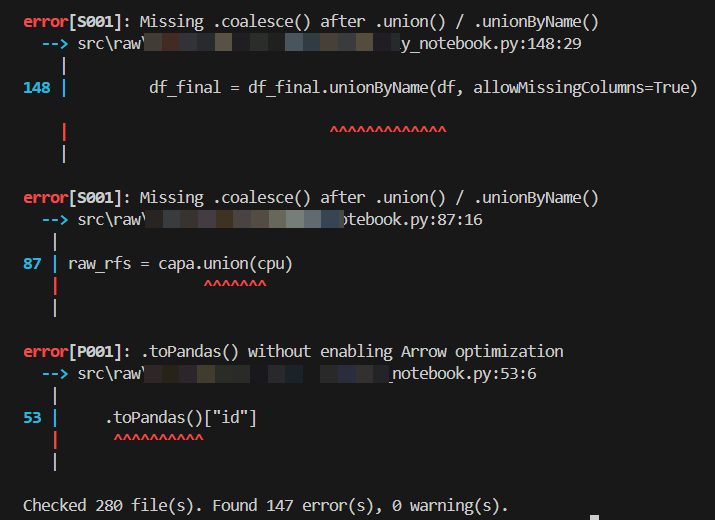
Each violation line includes a colored severity badge — [HIGH] in red, [MEDIUM] in yellow, [LOW] in green — immediately after the rule ID:
error[D001][HIGH]: Avoid using collect()
  --> pipeline.py:42:10
Filter by your cluster's PySpark version to suppress rules for newer APIs:
pyspark-antipattern check src/ --pyspark-version=3.3 # suppress rules requiring 3.4+Filter by severity directly from the CLI:
pyspark-antipattern check src/ --severity=high    # only HIGH violations
pyspark-antipattern check src/ --severity=medium  # MEDIUM and HIGH
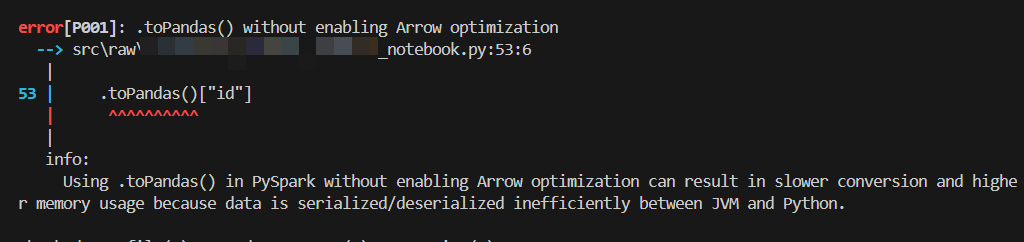
With show_information = true — inline explanation for each rule:
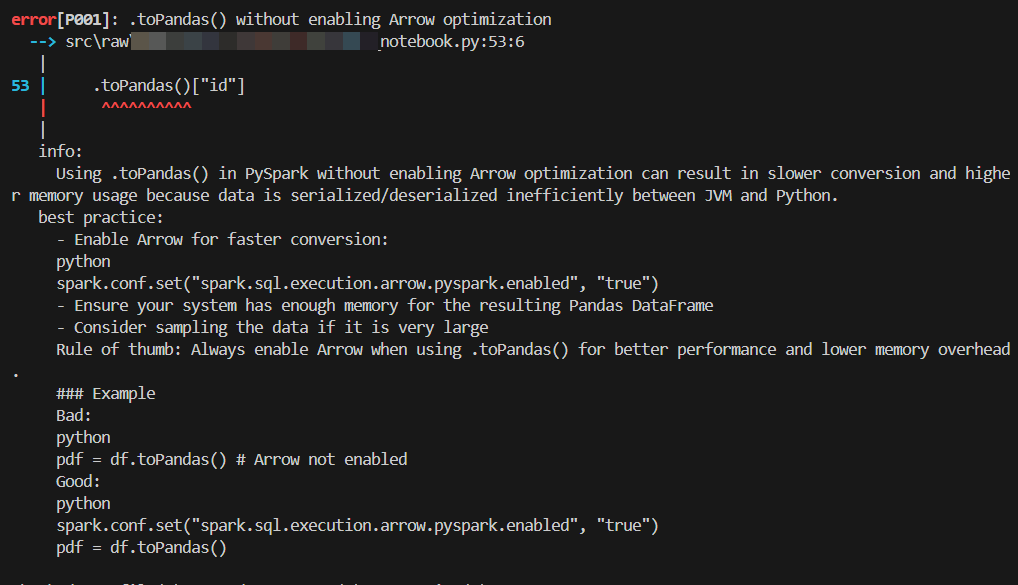
With show_best_practice = true — best-practice guidance for each rule:
Full documentation is available at https://skanderboudawara.github.io/pyspark-antipattern/.
Rules are organized by category in the docs/rules/ folder. Each rule has its own markdown file with a full explanation, best-practice guidance, and a severity badge indicating its performance impact.
| Category | Folder | Focus |
|---|---|---|
| ARR — Array | docs/rules/arr/ |
Array function antipatterns |
| D — Driver | docs/rules/driver/ |
Actions that pull data to the driver node |
| F — Format | docs/rules/format/ |
Code style and DataFrame API misuse |
| L — Looping | docs/rules/looping/ |
DataFrame operations inside loops |
| P — Pandas | docs/rules/pandas/ |
Pandas interop pitfalls |
| PERF — Performance | docs/rules/performance/ |
Runtime performance antipatterns |
| S — Shuffle | docs/rules/shuffle/ |
Joins, partitioning, and data movement |
| U — UDF | docs/rules/udf/ |
User-defined functions and their alternatives |
Each rule carries a severity reflecting its performance impact:
| Severity | Meaning |
|---|---|
| 🔴 HIGH | Major performance impact — OOM risk, full scans, shuffle explosion |
| 🟡 MEDIUM | Moderate performance impact — avoidable overhead at scale |
| 🟢 LOW | Minor impact — style, API correctness, small inefficiencies |
Add a [tool.pyspark-antipattern] section to your project's pyproject.toml:
[tool.pyspark-antipattern]

# Show only these rules — everything else is silenced (default: all active)
# select = ["D001", "S"]

# Cluster PySpark version — silences rules requiring a newer version (default: all)
# pyspark_version = "3.3"     # suppress rules that require PySpark 3.4+

# Downgrade these rules from error to warning (exit code stays 0)
warn = ["F008", "F011"]

# Completely silence these rules — no output, no exit code impact
# Accepts exact rule IDs or single-letter group prefixes
ignore = ["S004"]                # silence one rule
# ignore = ["F"]                 # silence all F rules
# ignore = ["S", "L", "D001"]    # silence all S and L rules

# Only report violations at or above this performance-impact level (default: all)
# severity = "medium"            # show only MEDIUM and HIGH violations
# severity = "high"              # show only HIGH violations

# Show inline explanation for each rule that fired (default: false)
show_information = false

# Show best-practice guidance for each rule that fired (default: false)
show_best_practice = false

# PERF003: fire when more than N shuffle ops occur without a checkpoint (default: 9)
max_shuffle_operations = 9

# S004: flag when the weighted count of .distinct() calls exceeds this (default: 5)
distinct_threshold = 5

# S008: flag when the weighted count of explode() calls exceeds this (default: 3)
explode_threshold = 3

# L001/L002/L003: flag for-loops where range(N) > threshold;
#                 while-loops always assume 99 iterations (default: 10)
loop_threshold = 10

# Directories to skip during recursive scanning (default: common build/venv dirs)
# exclude_dirs = ["my_generated_code", "vendor"]Add a # noqa: pap: RULE_ID comment to suppress one or more rules on that line:
result = df.collect()  # noqa: pap: D001
bad_join = df.crossJoin(other) # noqa: pap: S010, S002- name: Lint PySpark code
run: |
pip install pyspark-antipattern
pyspark-antipattern check src/The job fails automatically if any error-level rule fires. Warnings are reported but do not block the pipeline.
# .pre-commit-config.yaml
repos:
  - repo: local
    hooks:
      - id: pyspark-antipattern
        name: PySpark antipattern linter
        entry: pyspark-antipattern check
        language: system
        types: [python]
        pass_filenames: false
args: ["src/"]This linter will challenge code that your team may have written deliberately and knowingly. That is by design.
Each violation is not a verdict — it is a question: "Did you mean to do this, and do you understand the trade-off?" If the answer is yes, suppress the rule on that line or downgrade it to a warning in your config. If the answer is no, you just avoided a production issue.
The strictest setup is the default: every rule is a hard error. Relax only what you have a documented reason to relax.
Skander Boudawara — skander.education@proton.me