

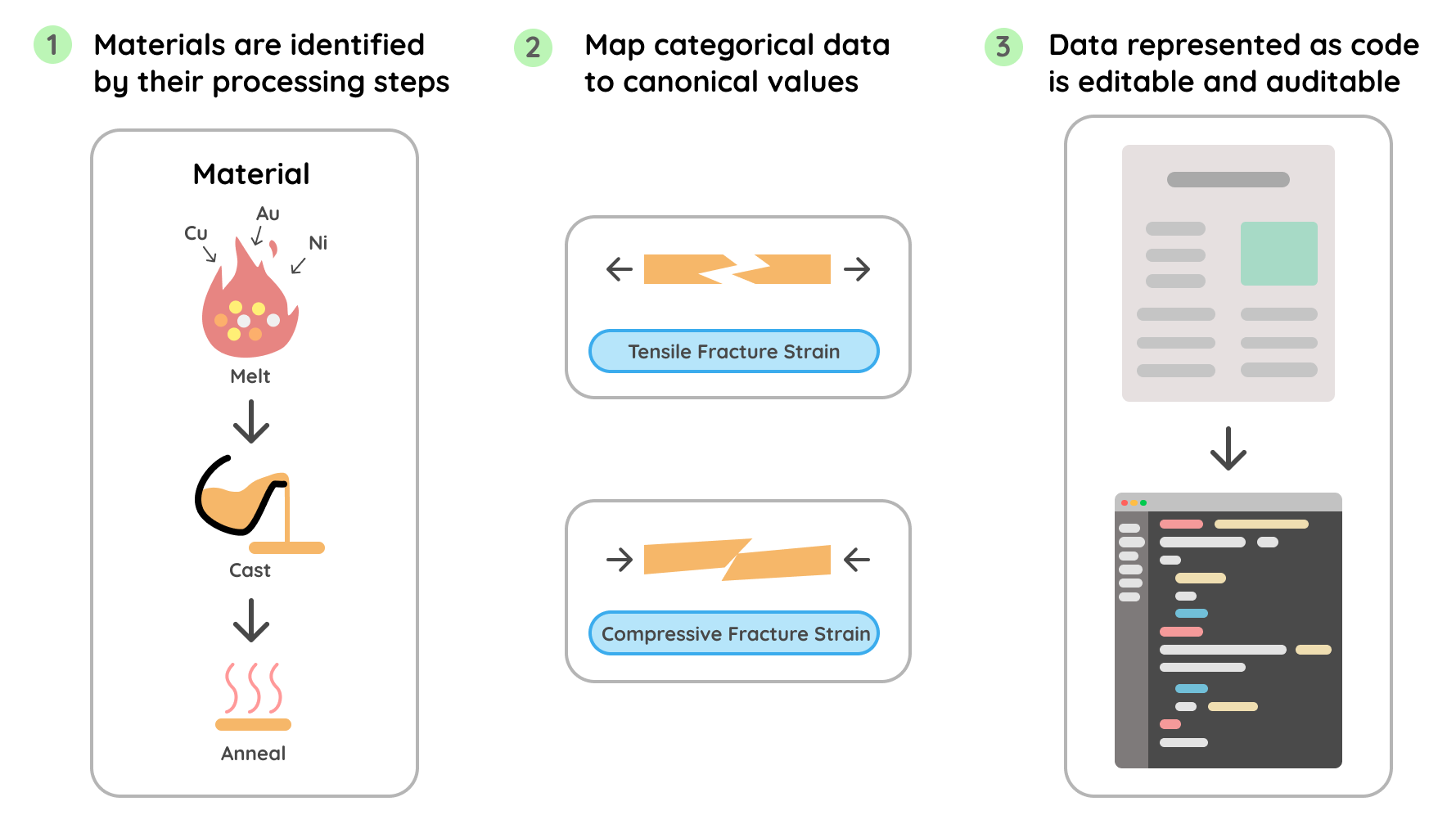
LitXBench is a benchmark to evaluate LLMs on extracting material information synthesized in research papers. Read the preprint here.
uv pip install litxbench
LitXBench ships with annotated ground-truth extractions. The litxalloy dataset contains 19 papers on alloys.
from litxbench.litxalloy import papers

# papers is a dict mapping DOI strings to list[Experiment]
doi = "doi_10_3390__e21020122"
ground_truth = papers[doi]Represent extracted materials as Experiment objects. Each experiment contains raw materials, synthesis groups (with optional template variables), and output materials with their measurements.
from pymatgen.core.composition import Composition
from litxbench import (
    CompMeasurement, Configuration, CrysStruct, Experiment, Material,
    Measurement, ProcessEvent, ProcessKind, Quantity, RawMaterial, RawMaterialKind,
)
from litxbench.core.models import GlobalLatticeParam
from litxbench.core.units import Celsius, Hour, MegaPascal, Nanometer, gram_per_cm3, percent, HV
from litxbench.litxalloy.models import AlloyMeasurementKind

extracted = [
    Experiment(
        raw_materials={"elements": RawMaterial(kind=RawMaterialKind.Powder)},
        # Synthesis groups can use template variables (e.g. [Duration], [Temp])
        # that are substituted per-material via process strings.
        synthesis_groups={
            "Milling[Duration]": [
                ProcessEvent(
                    kind=ProcessKind.PlanetaryMilling,
                    duration=Quantity(value="[Duration]", unit=Hour),
                ),
            ],
            "SPS[Temp]": [
                ProcessEvent(
                    kind=ProcessKind.SparkPlasmaSintering,
                    temperature=Quantity(value="[Temp]", unit=Celsius),
                ),
            ],
        },
        output_materials=[
            # Named materials can be referenced as inputs by later materials
            Material(
                process="elements->Milling[Duration=60]",
                name="base",
                measurements=[
                    CompMeasurement(Composition("CoCrNiCuZn")),
                    GlobalLatticeParam(
                        struct=CrysStruct.BCC,
                        phase_fraction=Quantity(value=100, unit=percent),
                    ),
                    Measurement(
                        kind=AlloyMeasurementKind.crystallite_size,
                        value=13,
                        unit=Nanometer,
                    ),
                    Measurement(
                        kind=AlloyMeasurementKind.lattice_strain,
                        value=0.7,
                        unit=percent,
                    ),
                    # Configurations represent distinct phases within a material
                    Configuration(
                        name="Phase 1",
                        measurements=[
                            Measurement(kind=AlloyMeasurementKind.solidus, value=1244.8, unit=Celsius),
                        ],
                    ),
                ],
            ),
            # This material chains from "base" through the SPS synthesis group
            Material(
                process="base->SPS[Temp=900]",
                measurements=[
                    CompMeasurement(Composition("CoCrNiCuZn")),
                    Measurement(kind=AlloyMeasurementKind.density, value=7.89, unit=gram_per_cm3),
                    Measurement(kind=AlloyMeasurementKind.ultimate_compressive_strength, value=2121, unit=MegaPascal),
                    Measurement(kind=AlloyMeasurementKind.vickers_hardness, value=615, unit=HV),
                    GlobalLatticeParam(struct=CrysStruct.FCC, name="FCC1"),
                    GlobalLatticeParam(struct=CrysStruct.FCC, name="FCC2"),
                ],
            ),
        ],
    ),
]Compare your extractions against the ground truth to get precision, recall, and F1 scores.
from litxbench import compare_experiments

result = compare_experiments(ground_truth, extracted)
print(f"Precision: {result.precision:.2%}")
print(f"Recall:    {result.recall:.2%}")
print(f"F1:        {result.f1:.2%}")
For multi-level metrics (value, process, configuration, and material levels):
from litxbench.core.eval import compute_multi_level_metrics

metrics = compute_multi_level_metrics(result)
print(f"Overall F1: {metrics.overall_f1:.2%}")
print(f"Value F1:   {metrics.value_f1:.2%}")
print(f"Process F1: {metrics.process_f1:.2%}")
A complete end-to-end example is available at examples/usage.py.
For the evaluation scripts used in the paper, LitXBench instructs LLMs to format the extracted materials as code. This code is run by LitXBench via Python exec. Do NOT call untrusted LLMs as they may generate untrusted code which could be executed on your machine.
If you use LitXBench in your research, please cite:
@article{chong2026litxbench,
  title         = {LitXBench: A Benchmark for Extracting Experiments from Scientific Literature},
  author        = {Curtis Chong and Jorge Colindres},
  year          = {2026},
  eprint        = {2604.07649},
  archivePrefix = {arXiv},
  primaryClass  = {cs.IR},
  url           = {https://arxiv.org/abs/2604.07649}
}
